> For the complete documentation index, see [llms.txt](https://docs.camflite.com/llms.txt). Markdown versions of documentation pages are available by appending `.md` to page URLs; this page is available as [Markdown](https://docs.camflite.com/crd1/ecosystem/batteries.md).
# Batteries
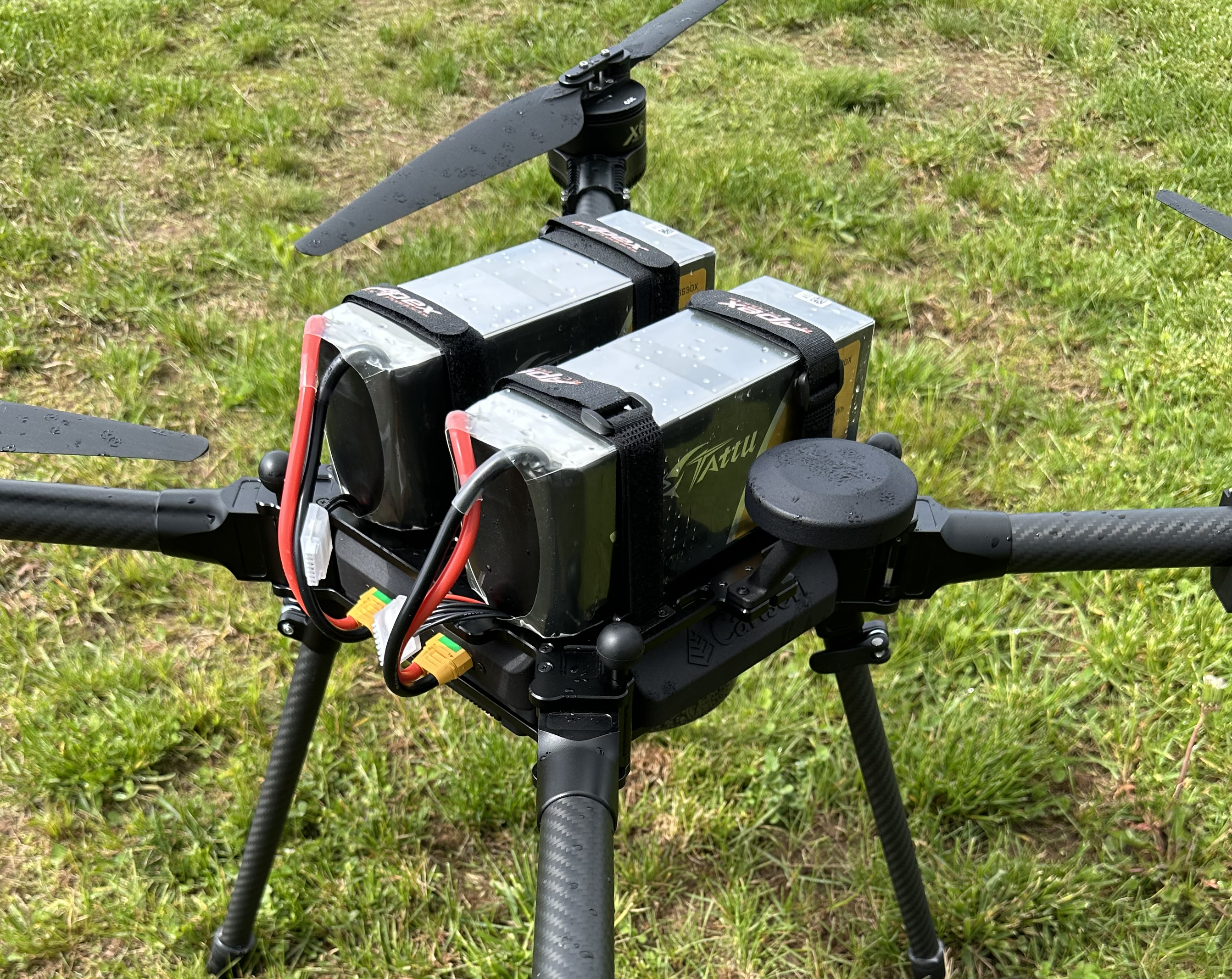
The CRD1 UAS is capable of accommodating various sizes of lipos. For optimal performance, we suggest using lipos with a capacity of 16Ah to 22Ah, 22.2V, and an X90 connector. Each pack is 6S (22.2V). CRD1 takes two of them, connected in series, for 12S (44.4V nominal, 50.4V full). Our battery solution offers affordable proprietary batteries and empowers our customers with the freedom to choose from a range of sizes, brands, and prices.
{% hint style="warning" %}
When utilizing HV Lipo batteries, it is crucial to charge them similarly to regular Lipo batteries by using the standard Lipo charge setting. This is because HV Lipo batteries necessitate a higher voltage of 4.4v per cell. Additionally, it's worth noting that Aurora employs motors that can operate up to a maximum of 52.2v.
{% endhint %}
Battiers Mounted using provided straps.
{% hint style="info" %}
During installation, it is crucial to ensure that the power wires do not come into contact with the spinning propellers.
{% endhint %}
Typical Reccommend lipo.
To ensure safety when using LiPo batteries, avoiding incorrect chargers and voltage cutoffs and discharging them beyond their capacity is essential. Fortunately, advancements in battery technology have made LiPo batteries a reliable and safe power source. To maximize safety, it's recommended to follow a few simple rules.
• Always store batteries in a fire-safe container.\
• Always charge with an appropriate charger designed for LiPos.\
• Always follow the manufacturer’s instructions for charging and discharging rates.\
• Always size a pack according to its usage.\
• Never overcharge.\
• Never over-discharge.\
• Never use a puffed pack.\
• Never use a pack with visible damage (dents, cracks, etc).\
• Never charge a pack unattended.\
• Never disassemble or reconfigure a damaged pack.
{% hint style="danger" %}
Many accidents involving LiPo packs occur due to failure to adhere to safety regulations. It is crucial to thoroughly comprehend the charger you are using and adhere to the manufacturer's instructions to ensure safe charging practices. Stay safe.
{% endhint %}
Battery Safety
These are the basics. Always follow the instructions from the maker of the packs you use.
* Check every pack before charging, flying and storing. Don't use a pack that is damaged, swollen or leaking, has a cell under 3.3V, or has cells that are way out of balance.
* Only charge with a LiPo balance charger set to the right cell count. Charge at 1C or less unless the battery maker says otherwise.
* Never leave packs charging unattended. Charge on a fireproof surface or in a fire-safe container, away from anything that can burn, and never inside a house, garage or vehicle.
* Charge between 32 and 110°F (0 to 43°C). Let packs cool down before recharging. If a pack gets hot, swells or smells, stop and move it somewhere safe.
* Don't run packs below 3.3V per cell, and never let a pack go over 140°F (60°C). Retire packs that have lost about 20% of their capacity.
* If you're storing packs for more than a week, leave them at 3.8 to 3.9V per cell, at room temperature, in a fire-safe container.
* After a crash, take the batteries out, check them over, and keep them somewhere safe for at least 30 minutes to make sure they don't heat up.
* Take damaged packs to a battery recycler. Don't keep using them.